Dental Abscess – Signs, Causes and When You Need Urgent Treatment
It often starts with something that seems easy to ignore.
Maybe one tooth feels slightly sore when you chew. Then cold water starts hurting. A few days later, your gum looks swollen. You notice a strange taste in your mouth, or perhaps a small bump has appeared beside the tooth.
And then the question comes: “Could this be an abscess?”
A dental abscess is not simply a bad toothache. It is a collection of pus caused by a bacterial infection in or around a tooth, and it needs dental treatment. It will not reliably disappear on its own.
The good news is that dental abscesses are treatable. The important part is not waiting until the swelling becomes severe or the pain becomes unbearable.
So, what does a dental abscess actually feel like? What causes it? Can an abscessed tooth be saved? And when does a dental infection become an emergency?
Let’s look at what you need to know.
What Does a Dental Abscess Feel Like?
A dental abscess does not always announce itself in the same way.
For some people, it starts as a deep, throbbing toothache. For others, the first noticeable sign is a swollen gum or pain when biting.
Common dental abscess symptoms include:
- Intense or persistent toothache
- Pain when biting or chewing
- Sensitivity to hot or cold foods and drinks
- Swelling around the tooth or gum
- A swollen cheek or jaw
- Redness around the affected area
- A bad taste or unpleasant smell in the mouth
- A pimple-like bump on the gum
- Fever or feeling generally unwell
- Swollen glands in the neck
- Difficulty opening the mouth
These symptoms can vary depending on where the infection has developed.
You may have only a few of them.
That is why it is not a good idea to wait until you have every typical symptom before seeing a dentist.
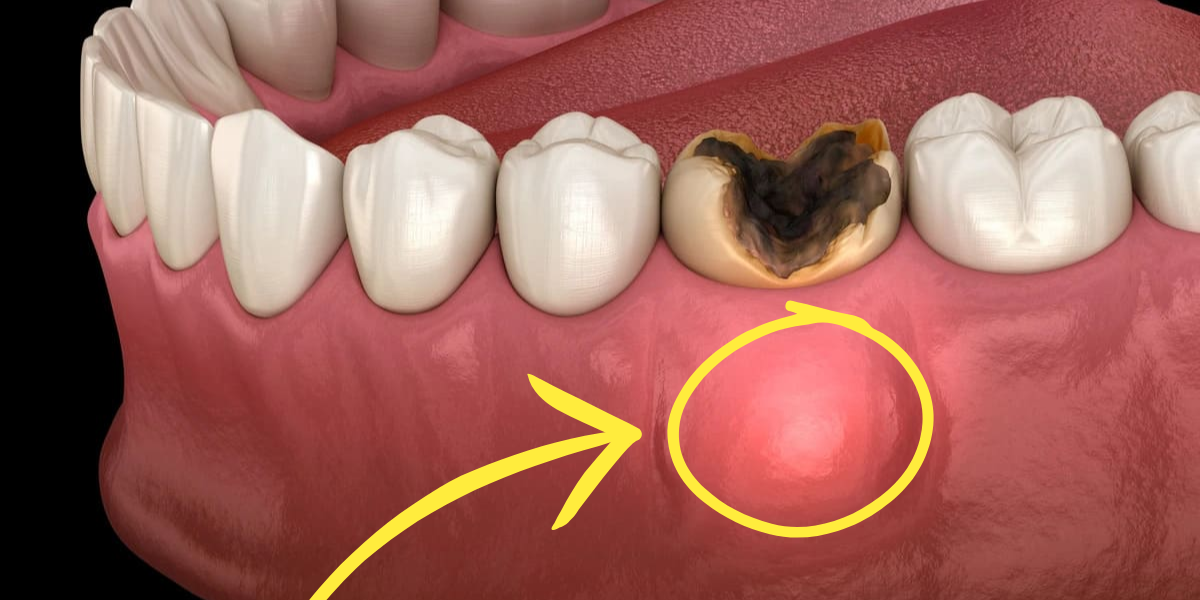
What does an abscess on the gum look like?
One of the more recognisable signs is a small bump on the gum near a painful tooth.
It may look a little like a pimple. Sometimes it can release pus or a fluid with a bad or salty taste.
You might actually feel some relief after this happens because the pressure has been released.
But this is where people can make a dangerous assumption.
If the abscess drains and the pain gets better, the infection has not necessarily gone away.
The source of the infection may still be inside the tooth or in the surrounding tissues. You still need dental treatment to address the underlying problem.
Why Does a Dental Abscess Happen?
Usually, there is a story behind it.
Perhaps a cavity was left untreated. Perhaps a tooth cracked. Maybe an old filling failed. Or gum disease created an area where bacteria could build up.
Deep tooth decay
A small cavity may not hurt at first.
But tooth decay does not necessarily stop where you can see it. If it progresses through the enamel and dentine and reaches the pulp inside the tooth, bacteria can infect the soft tissue containing the tooth’s nerves and blood vessels.
The infection can then spread through the root and form an abscess around the root tip.
This is one reason why treating a cavity early is so much simpler than waiting until the tooth becomes infected.
A cracked or broken tooth
A cracked tooth can provide bacteria with a route into deeper parts of the tooth.
Sometimes the crack is obvious. Sometimes it is so small that you would never notice it yourself.
You may first experience pain when biting, sensitivity to cold or discomfort that seems to come from one particular tooth.
If bacteria reach the pulp through the damaged area, an infection can eventually develop.
Gum disease
Not every dental abscess starts inside the tooth.
A periodontal abscess develops in the gum and supporting tissues around a tooth. It can occur in association with gum disease and areas where bacteria and debris become trapped.
If you have a swollen, painful gum alongside bleeding gums, persistent bad breath or a loose tooth, your dentist will need to assess the gums as well as the tooth.
Dental injury
A blow to the mouth can damage a tooth even when there is no obvious crack.
Trauma can affect the pulp inside the tooth. In some cases, that damaged pulp can later become infected.
If you have ever injured the tooth, tell your dentist. It can be an important part of understanding what has happened.
Tooth Abscess or Ordinary Toothache?
This is where things can become confusing.
A toothache does not automatically mean you have an abscess.
A cavity can hurt without an abscess. A cracked tooth can cause sharp pain when you bite. Sensitive teeth can react strongly to cold drinks. Gum inflammation can also make a tooth feel sore.
An abscess becomes more concerning when tooth or gum pain occurs with swelling, pus, a bad taste, fever or a visible bump on the gum.
You cannot confirm an abscess simply by looking at the tooth, though. A dentist may need to examine the tooth, test how it responds and take an X-ray to understand what is happening beneath the surface.
That distinction matters because the treatment depends on the source of the problem.
Can a Dental Abscess Go Away by Itself?
This is probably one of the most important questions people ask.
No, you should not expect a dental abscess to go away on its own.
The pain may reduce. The swelling may temporarily change. The abscess may even drain.
But none of those things necessarily means the infection has been eliminated.
Think about it this way: if an infected tooth is still allowing bacteria to enter the surrounding tissues, the source of the problem is still there.
An untreated infection can spread into nearby tissues and, in serious cases, become a much more complicated medical problem.
So if you suspect you have a tooth abscess, do not use a temporary reduction in pain as a reason to postpone treatment.
When Should You See a Dentist?
If you think you have a dental abscess, you should arrange an urgent dental appointment.
Do not wait for your next routine check-up.
You should seek prompt dental care if you have:
- Severe or persistent tooth pain
- Swelling around a tooth or gum
- A pimple-like bump on the gum
- Pus or a bad taste in your mouth
- Pain when biting
- Fever alongside dental pain
- Swelling of the cheek or jaw
- Difficulty opening your mouth
Current NHS guidance specifically advises urgent dental assessment when you think you have a dental abscess.
The sooner the source of the infection is treated, the more options your dentist may have for managing the tooth.
When Does a Dental Abscess Become an Emergency?
There is an important difference between urgent dental treatment and a medical emergency.
Most suspected dental abscesses need urgent attention from a dentist.
But if the infection causes significant swelling or begins affecting your ability to breathe or swallow, the situation is more serious.
Seek emergency medical care if:
- You are struggling to breathe
- You are having difficulty swallowing
- You are finding it difficult to speak
- There is severe swelling inside your mouth
- Your face or neck is becoming significantly swollen
- Your eye is swollen or painful
- Your vision is suddenly affected
- You cannot open your mouth properly because of severe swelling
These can be signs that an infection is spreading into deeper tissues. NHS guidance advises emergency care for symptoms such as difficulty breathing, speaking or swallowing, significant mouth swelling, or swelling around the eye.
Do not wait for a dental appointment in these circumstances.
How Does a Dentist Diagnose an Abscessed Tooth?
You might be able to point to the tooth that hurts, but that does not always tell the dentist where the infection began.
Your dentist will usually examine the tooth and surrounding gums and ask about your symptoms.
They may check:
- Whether the tooth is painful when tapped
- Whether biting causes pain
- How the tooth responds to temperature
- Whether the gum is swollen
- Whether there is pus or drainage
- Whether the tooth is cracked or damaged
- Whether there are signs of gum disease
An X-ray may be used to look for infection around the root and understand the condition of the tooth beneath the visible surface.
This examination helps answer an important question:
Can the tooth be saved, or does it need to be removed?
What Is the Treatment for a Dental Abscess?
There is no single treatment for every abscessed tooth.
The dentist needs to control the infection while also dealing with the source of it.
Drainage of the abscess
If pus has collected, the dentist may drain the abscess.
This can reduce pressure and help manage the infection, but drainage alone may not fix the original problem if the infection started inside the tooth.
The infected tooth may still need root canal treatment or extraction.
Root canal treatment
If the tooth can be saved, root canal treatment may be an option.
During a root canal, the infected or damaged pulp is removed from inside the tooth. The canals are cleaned and sealed, and the tooth is then restored.
The purpose is not simply to stop the pain. It is to remove the infected tissue while allowing the natural tooth to remain in place.
For a restorable tooth with infection inside it, this can be an important way of avoiding extraction.
Tooth extraction
Sometimes the damage is too extensive to save the tooth.
If the tooth is severely broken, extensively decayed or otherwise cannot be restored, extraction may be necessary.
Removing the affected tooth removes the source of infection. Your dentist can then discuss whether the missing tooth should later be replaced.
What about antibiotics?
This is an area where patients often expect a simple answer:
“I have an infection, so I need antibiotics.”
But dental infections do not always work that way.
Current American Dental Association guidance recommends against antibiotics for most localised pulpal and periapical dental conditions when definitive dental treatment is available. Instead, treatment such as drainage or root canal treatment should address the source of the infection. Antibiotics may be appropriate when there is systemic involvement, such as fever or malaise, or in specific situations where the infection is spreading or definitive treatment is not immediately available.
That is why you should not take leftover antibiotics or someone else’s prescription.
An antibiotic may help in the situations where it is genuinely needed, but it does not repair a cavity, seal a crack or remove infected pulp.
The source of the infection still needs to be treated.
What Can You Do Until You See a Dentist?
If you have a suspected abscess, home care should only be viewed as temporary comfort while you arrange professional treatment.
You can:
- Eat softer foods.
- Chew on the opposite side of your mouth.
- Avoid very hot or very cold food and drinks.
- Keep brushing gently around the affected area.
- Clean between your teeth carefully.
- Rinse gently with warm salt water if it feels soothing.
- Use an appropriate over-the-counter pain reliever if you can safely take it and follow the instructions on the label.
Avoid placing aspirin or other painkillers directly on the gum or tooth. This can irritate the tissues.
And do not try to puncture, squeeze or drain the abscess yourself.
You may get temporary relief, but you can also injure the surrounding tissue and still leave the underlying infection untreated.
What Happens If You Ignore a Dental Abscess?
This is where a “I’ll wait a few more days” approach can become risky.
An abscess may remain localised for a while, but there is no reliable way to predict how an infection will behave in an individual person.
The infection can spread into surrounding tissues. Severe dental infections can involve the jaw, face and neck and, in rare cases, become life-threatening.
There is another concern too.
The longer an infected tooth remains untreated, the more difficult it may become to preserve the tooth.
A tooth that might have been treated with root canal therapy at an earlier stage may eventually become too damaged to restore.
So the question should not be:
“Can I tolerate the pain for another week?”
It should be:
“What is causing this infection, and how quickly can I get it treated?”
Can an Abscessed Tooth Be Saved?
Often, yes.
An abscess does not automatically mean that the tooth has to be extracted.
If the tooth has enough healthy structure remaining and can be properly restored, root canal treatment may allow the natural tooth to be retained.
But the decision depends on factors such as:
- How much tooth structure remains
- The extent and location of decay
- Whether the tooth is cracked
- The condition of the surrounding bone and gums
- Whether the tooth can be restored properly
This is why it is worth getting an assessment before assuming that extraction is the only option.
How Can You Prevent a Dental Abscess?
Most dental abscesses do not appear out of nowhere.
They often develop after a problem such as tooth decay, a crack or gum disease has been left untreated.
That means prevention starts with the basics.
Brush your teeth twice a day with fluoride toothpaste and clean between your teeth every day. Limit frequent sugary foods and drinks, and attend regular dental examinations so that problems can be identified before they become painful or infected.
If you notice a cavity, a broken filling, a cracked tooth, bleeding gums or repeated tooth sensitivity, do not keep waiting for pain to force you into treatment.
Dental problems are generally easier to manage when they are found early.
A Final Question: Should You Wait for the Pain to Become Severe?
No.
This is perhaps the biggest takeaway from a dental abscess.
You do not need to wait until your cheek is visibly swollen, you have a fever or the pain becomes unbearable before seeking help.
If you have persistent tooth pain, swelling, pus or a bad taste around a particular tooth, arrange an urgent dental examination.
And if you develop difficulty breathing, swallowing or speaking, or severe swelling of the face, mouth or neck, seek emergency medical care immediately.
So, What We Learn from this?
A dental abscess is a bacterial infection that causes a collection of pus in or around a tooth. It can develop because of deep decay, a cracked or damaged tooth, gum disease or other problems that allow bacteria to reach deeper tissues.
The warning signs can include severe toothache, pain when biting, swelling, sensitivity, pus, a bad taste, fever and a swollen area on the gum.
Most importantly, a dental abscess does not reliably disappear on its own. Even if the pain suddenly improves after the abscess drains, the infection may still be present.
Treatment depends on the condition of the tooth. It may involve drainage, root canal treatment or extraction. Antibiotics are not automatically needed for every dental abscess and should only be used when clinically appropriate.
If you suspect you have an abscessed tooth, getting it checked early can help prevent the problem from becoming more complicated.
If you need urgent help with severe tooth pain, swelling or a suspected dental abscess, Smile Town is an emergency dentistry clinic in Kolkata where the cause of the problem can be assessed and the appropriate treatment can be planned.