
What Is a Smile Makeover and Which Dental Treatments Does It Include?
When you hear the words smile makeover, it is easy to imagine one particular treatment.
For some people, that means veneers. For others, it means teeth whitening, braces, dental bonding or a completely new set of front teeth.
The reality is much more useful than that.
A smile makeover is not one specific dental procedure. It is a personalised treatment plan that may combine two or more cosmetic and restorative dental treatments depending on what needs to change in your smile. Teeth whitening, bonding, veneers, orthodontics, crowns, gum contouring, bridges and dental implants can all form part of a smile makeover in suitable cases.
And that distinction matters.
Someone with otherwise healthy teeth but stubborn staining may only need professional whitening. Someone with chipped front teeth may benefit from bonding or veneers. Someone with crowded teeth may need orthodontic treatment before any cosmetic work is considered. A person with missing teeth may need implants or a bridge.
So, a smile makeover is less about buying a particular package and more about answering a simple question:
What does your smile actually need?
Let’s look at how dentists approach that question.
What Is a Smile Makeover?
A smile makeover is a customised combination of dental treatments planned to improve the appearance of your smile and, where necessary, restore its function and oral health.
It can address concerns involving:
- Tooth colour
- Tooth shape
- Tooth size
- Tooth alignment
- Gaps between teeth
- Chipped or worn teeth
- Uneven gum lines
- Missing teeth
- Damaged or weakened teeth
The exact combination varies from person to person. There is no universal checklist that every patient needs to complete.
That is why two people can both ask for a “smile makeover” and end up with completely different treatment plans.
One might have whitening and composite bonding.
Another might need clear aligners followed by veneers.
Someone else may need crowns, gum treatment and tooth replacement before cosmetic improvements are considered.
Current dental guidance also makes an important distinction between cosmetic and restorative dentistry. Cosmetic dentistry primarily focuses on improving appearance, while restorative dentistry repairs or replaces damaged or missing teeth and restores function. In a comprehensive smile makeover, the two can overlap.
What Can a Smile Makeover Improve?
Before discussing the treatments, it helps to understand the problems a smile makeover may address.
Discoloured or stained teeth
Teeth can become darker or develop stains because of ageing, food and drinks, tobacco use, certain medications or changes within the tooth itself.
Professional whitening may be suitable when the main concern is tooth colour and the teeth are otherwise healthy. However, whitening does not work equally well for every type of discolouration and does not change the colour of existing veneers, crowns or fillings.
For some types of deeper or persistent discolouration, bonding or veneers may be considered instead.
Chipped or worn teeth
A small chip can often be repaired with tooth-coloured composite bonding.
More extensive damage may require a veneer, crown or another restorative treatment depending on how much of the tooth is intact. A badly damaged tooth should not simply be treated as a cosmetic problem because its structure and health need to be assessed first.
Uneven tooth shape
Sometimes the teeth are healthy but one or more look too short, narrow, wide, pointed or irregular.
Bonding, veneers or carefully planned tooth reshaping may be considered depending on how much needs to change.
Gaps between teeth
Small gaps can sometimes be improved using dental bonding or veneers.
However, orthodontic treatment may be more appropriate when the gap is related to tooth position or when several teeth need to be moved. Clear aligners and braces are designed to physically reposition teeth, something veneers and bonding do not do.
Crowded or misaligned teeth
If the main problem is alignment, a cosmetic restoration may not address the actual issue.
Orthodontic treatment can gradually move teeth into better positions using braces or clear aligners. In some smile makeover plans, alignment is addressed before cosmetic restorations are placed.
Uneven or excessive gum display
Sometimes people focus on the teeth when the gum line is actually a major part of the appearance of the smile.
Gum contouring can reshape excess gum tissue or an uneven gum line in suitable cases. The procedure may help create a more balanced relationship between the gums and teeth, but it should only be considered after the dentist has assessed the gum health and underlying anatomy.
Missing teeth
A missing tooth is more than a cosmetic concern.
Depending on the situation, a dental implant, bridge or denture may be used to replace missing teeth and restore function as well as appearance. Dental implants can support crowns, bridges or dentures, while bridges replace one or more missing teeth by spanning the gap.
This is where a smile makeover can move beyond purely cosmetic dentistry and become a combination of aesthetic and restorative treatment.
Which Treatments Are Included in a Smile Makeover?
There is no fixed list, but some treatments appear frequently in smile makeover plans.
1. Professional Teeth Whitening
If the teeth have the right shape and alignment but the colour is the main concern, whitening may be all that is needed.
Professional whitening uses bleaching agents such as hydrogen peroxide or carbamide peroxide to break down stains and lighten natural teeth. The treatment can be performed in a dental clinic or through dentist-supervised home systems, depending on the approach.
Whitening is often considered before restorations because it is important to know the desired shade of the natural teeth before choosing the colour of bonding or veneers.
There is also a practical reason to avoid rushing into veneers for simple staining.
If whitening can give you the improvement you want without altering the tooth structure, a more conservative treatment may make more sense.
2. Dental Bonding
Dental bonding uses tooth-coloured composite resin to alter or repair the visible portion of a tooth.
It can be useful for:
- Small chips
- Minor gaps
- Slightly uneven edges
- Tooth shape changes
- Certain areas of discolouration
One of the main attractions of bonding is that it is generally minimally invasive. It typically does not require significant enamel removal and can often be completed in a single visit.
The limitation is durability.
Composite bonding can chip and stain over time and generally does not have the same stain or wear resistance as porcelain. Cleveland Clinic notes that bonding commonly lasts around three to 10 years, although individual results vary.
That does not make bonding inferior. It simply makes it suitable for different situations.
3. Dental Veneers
Veneers are thin coverings bonded to the front surface of teeth to change their appearance.
They may be used to address issues such as:
- Persistent discolouration
- Chipped teeth
- Certain gaps
- Misshapen teeth
- Cosmetic irregularities
Porcelain veneers can create a coordinated appearance across several front teeth, which is why they are often associated with smile makeovers.
However, traditional veneers usually involve removing a small amount of enamel. Because enamel is removed, conventional veneer treatment is generally irreversible. They can also chip, crack, loosen or eventually require replacement.
So veneers can produce a significant cosmetic change, but they should not be treated as a casual or temporary procedure.
4. Clear Aligners or Braces
Not every smile needs to be reshaped.
Sometimes it needs to be moved.
Clear aligners and braces can gradually reposition teeth affected by crowding, spacing or other alignment problems. Clear aligners use a series of custom-made trays, while traditional braces use brackets and wires to apply controlled forces to the teeth.
Orthodontic treatment may sometimes be completed before veneers, bonding or other cosmetic work.
This approach can be useful because moving the teeth into a better position may reduce the amount of cosmetic alteration needed later.
It also addresses the alignment itself instead of simply making misaligned teeth look straighter.
5. Dental Crowns
A crown is different from a veneer.
A veneer mainly covers the visible front surface. A crown is designed to cover the entire tooth and is used to restore teeth that are weakened, broken, worn down or significantly affected by decay.
Crowns can therefore have both functional and cosmetic value.
For example, a badly damaged front tooth may need a crown that restores its strength and also matches the appearance of neighbouring teeth.
The important point is that crowns should generally be chosen because the tooth needs that level of restoration, not simply because a crown can change its appearance.
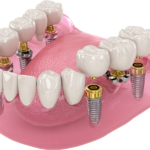
6. Dental Implants
If one or more teeth are missing, implants may form part of a broader smile makeover plan.
A dental implant acts as an artificial tooth root and can support a crown, bridge or implant-supported denture. Unlike a traditional tooth-supported bridge, an implant does not require the neighbouring natural tooth to be reduced for support.
Implant treatment is more involved than a simple cosmetic procedure.
It may involve surgery, healing and several stages of treatment. Adequate bone support is also important, and some patients may need additional procedures such as bone grafting.
This means an implant-based smile makeover can take considerably longer than whitening or bonding.
7. Dental Bridges
Bridges are another way to replace missing teeth.
A traditional bridge uses supporting teeth on either side of a gap, with an artificial tooth or teeth filling the space. Other bridge designs, including implant-supported bridges, may be considered depending on the situation.
The right option depends on the number of missing teeth, the condition of the neighbouring teeth, gum health, available bone and other individual factors.
8. Gum Contouring
Your teeth are not the only part of your smile.
If too much gum tissue shows when you smile or the gum line is uneven, gum contouring may be considered.
The procedure reshapes excess gum tissue to create a more balanced gum-to-tooth relationship. The dentist also considers factors such as lip position, tooth wear and facial structure when planning the result.
Gum contouring is not appropriate for everyone, particularly when active gum disease or other dental problems are present.
9. Tooth Reshaping
Sometimes very small changes can make a surprisingly noticeable difference.
Tooth reshaping, also called enameloplasty in certain contexts, involves removing very small amounts of enamel to alter the shape of a tooth.
It may be considered for minor irregularities, but enamel cannot simply be added back after it has been removed. Cleveland Clinic notes that because natural enamel is limited, there is a limit to how much tooth contouring can safely be performed.
This is another reason conservative treatment planning matters.
Does a Smile Makeover Always Include Veneers?
No.
This is one of the biggest misunderstandings surrounding the term.
A person can have a smile makeover without getting veneers at all.
For example, suppose someone has:
- Healthy teeth
- Mild staining
- A small chip
- Slightly uneven edges
The appropriate plan might involve professional whitening followed by composite bonding.
Someone else may have crowded teeth and want to improve alignment. Their plan might focus primarily on orthodontic treatment.
Another person may have several missing teeth and weakened neighbouring teeth, making restorative work more important than cosmetic veneers.
So, a smile makeover is not defined by veneers. It is defined by the overall treatment plan created around the patient’s smile.
What Happens Before a Smile Makeover?
The most important part of a smile makeover may happen before any visible cosmetic treatment begins.
It is the assessment.
Your dentist needs to understand the condition of your teeth and gums, your bite, existing dental work, missing teeth, tooth wear and the changes you want to make.
Active oral health problems should be addressed before elective cosmetic work.
For example, untreated cavities and gum disease need proper treatment rather than simply being covered by a cosmetic restoration. The ADA also advises treating existing dental problems before veneer placement.
Depending on your situation, the planning process may involve photographs, dental scans, X-rays, impressions and a discussion about the shape, shade and overall appearance you want.
Your dentist may also look at how your teeth relate to your lips and gums when you smile.
This matters because a smile does not exist separately from the rest of your face.
How Is a Smile Makeover Planned?
A sensible smile makeover usually starts with the biggest underlying issue rather than the most visible one.
Imagine someone has crooked, stained and slightly chipped front teeth.
It would be tempting to immediately discuss veneers.
But the dentist may first recommend orthodontic treatment to improve the alignment. Whitening may then be considered to establish a new tooth shade, followed by limited bonding or another restorative treatment.
The final plan can therefore be very different from what the patient initially expected.
This step-by-step thinking is important because some smile makeover treatments are conservative while others permanently alter teeth.
For example, whitening does not require drilling the tooth, while traditional veneers involve enamel preparation.
How Long Does a Smile Makeover Take?
There is no universal timeline.
A straightforward treatment involving whitening or a small amount of bonding may be completed relatively quickly.
A plan involving several veneers generally requires more than one stage.
Orthodontic treatment can take considerably longer because the teeth need to move gradually.
Implant treatment can also extend over several months because the implant and surrounding bone need time to heal before the final restoration is completed.
A smile makeover combining several of these treatments can therefore take weeks, months or longer depending on what is involved.
This is why a clinic promising the same “smile makeover in X days” for everyone should be approached carefully. The right timeline comes from the treatment plan, not the marketing package.
How Much Does a Smile Makeover Cost?
There is no single price for a smile makeover because there is no single treatment.
The cost can change significantly depending on:
- Number of teeth treated
- Type of treatment
- Veneer or crown material
- Need for orthodontics
- Number of implants or replacement teeth
- Gum procedures
- Existing dental problems
- Laboratory work
- Number of appointments and stages
A simple whitening treatment and a comprehensive plan involving orthodontics, multiple veneers and dental implants obviously represent very different levels of treatment.
This is why comparing “smile makeover prices” between clinics can be misleading unless you are comparing the same procedures, materials and scope of work.
A detailed treatment plan and written estimate are much more useful than a headline package price.
Is a Smile Makeover Only Cosmetic?
Not necessarily.
Some smile makeover treatments are primarily aesthetic, such as whitening or certain forms of bonding.
Others can improve both appearance and function.
Crowns can restore damaged teeth. Orthodontic treatment can improve tooth position and bite relationships. Bridges and implants can replace missing teeth. Restorative dentistry is specifically focused on repairing or replacing damaged or missing teeth to improve oral health and function.
This overlap is why a well-planned makeover should not separate “beauty” from oral health.
A smile that looks good but is built on untreated disease is not a successful long-term outcome.
Who Is a Good Candidate for a Smile Makeover?
A person does not need to have a “bad smile” to consider cosmetic dental treatment.
You may be a candidate if you have specific concerns about the colour, shape, alignment, spacing or appearance of your teeth and you are in suitable oral health.
The most important factor is not how many cosmetic imperfections you can find in the mirror.
It is whether those concerns can be addressed safely and predictably.
People with active tooth decay, untreated gum disease, significant tooth damage or other unresolved oral health problems may need treatment for those issues first.
People who grind or clench their teeth may also need specific assessment before certain cosmetic restorations are considered. The ADA notes that clenching or grinding and a deep overbite can make veneers unsuitable in some cases.
A good candidate also needs realistic expectations.
A smile makeover should improve the appearance of your teeth while respecting your natural anatomy, oral health and long-term needs.
What Are the Risks of a Smile Makeover?
The risks depend entirely on which procedures are involved.
Whitening can cause temporary sensitivity.
Bonding can chip or become stained.
Veneers can chip, crack, loosen or require replacement, and traditional veneer treatment is generally irreversible.
Gum contouring is a surgical procedure and carries potential complications including infection or gum tissue regrowth.
Implant treatment involves surgery and a healing period, with outcomes influenced by bone support, oral health and other individual factors.
The best way to reduce avoidable problems is not to select the biggest possible treatment plan.
It is to select the treatment that is appropriate for the problem.
What Should You Ask Before Starting a Smile Makeover?
Before committing to treatment, it is worth asking your dentist some very practical questions.
What exactly are we trying to change?
Which problems are cosmetic and which need restorative treatment?
Can whitening or bonding achieve the result without altering healthy tooth structure?
Do I need orthodontic treatment before veneers or bonding?
How much natural tooth structure will be removed?
How long should each restoration reasonably be expected to last?
What maintenance will I need?
What happens if a restoration chips or fails?
And perhaps the most important question:
What would you recommend if preserving my natural teeth were the priority?
That question can change the entire conversation.
Smile Makeover vs Full Mouth Rehabilitation
These terms are sometimes used interchangeably online, but they do not necessarily mean the same thing.
A smile makeover is primarily focused on improving the appearance of the smile, although restorative treatments may be included when necessary.
Full mouth rehabilitation is generally much more focused on rebuilding oral health and function across many parts of the mouth. It may involve extensive restorative treatment for severely worn, damaged, decayed or missing teeth.
Someone seeking a cosmetic improvement does not automatically need full mouth rehabilitation.
Conversely, someone with extensive dental disease or tooth wear may need much more than a purely cosmetic smile makeover.
The treatment should follow the dental problem, not the name attached to the package.
How Do You Maintain a Smile Makeover?
The finished treatment still needs everyday care.
Continue brushing twice a day with fluoride toothpaste, clean between your teeth daily and attend regular dental examinations.
Avoid using your teeth to open packages or bite very hard objects.
If you have a habit of grinding or clenching, discuss it with your dentist because repeated excessive forces can affect dental restorations.
Maintenance also depends on the treatment.
Whitening may need occasional maintenance because natural teeth can gradually pick up stains again.
Composite bonding may eventually need polishing, repair or replacement.
Veneers and crowns can also require replacement over time.
Implants themselves can be long-lasting, but their restorations and surrounding oral tissues still need regular care and professional monitoring.
A smile makeover is therefore not something you “finish” and forget.
It is a long-term investment in dental care.
So, What We Learn from this?
A smile makeover is best understood as a personalised dental plan rather than a single cosmetic procedure.
It can include teeth whitening, bonding, veneers, braces or clear aligners, crowns, gum contouring, bridges, dental implants and other treatments depending on what your smile actually needs.
The important part is the order of thinking.
First, your dentist should understand the health and condition of your teeth and gums. Then comes the question of alignment, tooth structure, colour, shape, proportions and your own expectations. Only after that should the specific treatments be selected.
Sometimes the answer may be veneers.
Sometimes it may simply be whitening and bonding.
And sometimes the most appropriate smile makeover starts with fixing a dental problem that cannot be seen in a photograph.
For patients exploring cosmetic and restorative options, Smile Town can help you plan treatment with a trusted dentist in Kolkata, based on your oral health, smile goals and the changes that genuinely make sense for you.
Frequently Asked Questions About Smile Makeovers
Not exactly. Cosmetic dentistry is the broader field focused on improving the appearance of the teeth and smile. A smile makeover is a personalised treatment plan that may combine several cosmetic and restorative procedures for one patient.
No. Veneers are only one possible treatment. Depending on your needs, a smile makeover may involve whitening, bonding, orthodontics, crowns, gum contouring, implants, bridges or a combination of treatments.
Yes. When tooth position or spacing is an important part of the concern, orthodontic treatment may be included. Braces and clear aligners physically move teeth, unlike veneers and bonding.
It can include treatment for missing teeth, such as dental implants, bridges or dentures. The choice depends on factors including the number of missing teeth, the condition of the surrounding teeth and the available bone.
There is no single lifespan because each smile makeover contains different treatments. Bonding, veneers, whitening, crowns and implants all have different maintenance and longevity considerations.